German Cancer Aid Funds Trial on Liver Transplantation for Colorectal Liver Metastases

Colorectal cancer is one of the leading causes of cancer-related death worldwide; about half of all patients develop metastases, most often in the liver. Surgical removal is the only potentially curative treatment, but only 20 to 40 percent of patients are eligible. If the metastases can be treated neither surgically nor by interventional procedures, palliative chemotherapy remains the only option, with a 5-year survival rate of around 10 percent.
In 2024, the randomized European TransMet trial led by Prof. René Adam (Paris) showed in The Lancet that selected patients benefit substantially from liver transplantation: five years after transplantation plus chemotherapy, 73 percent of participants were alive, compared with 9 percent on chemotherapy alone. In Germany, liver transplantation for this indication is currently possible only within clinical trials.
Rigorous patient selection by a National Tumor Board.
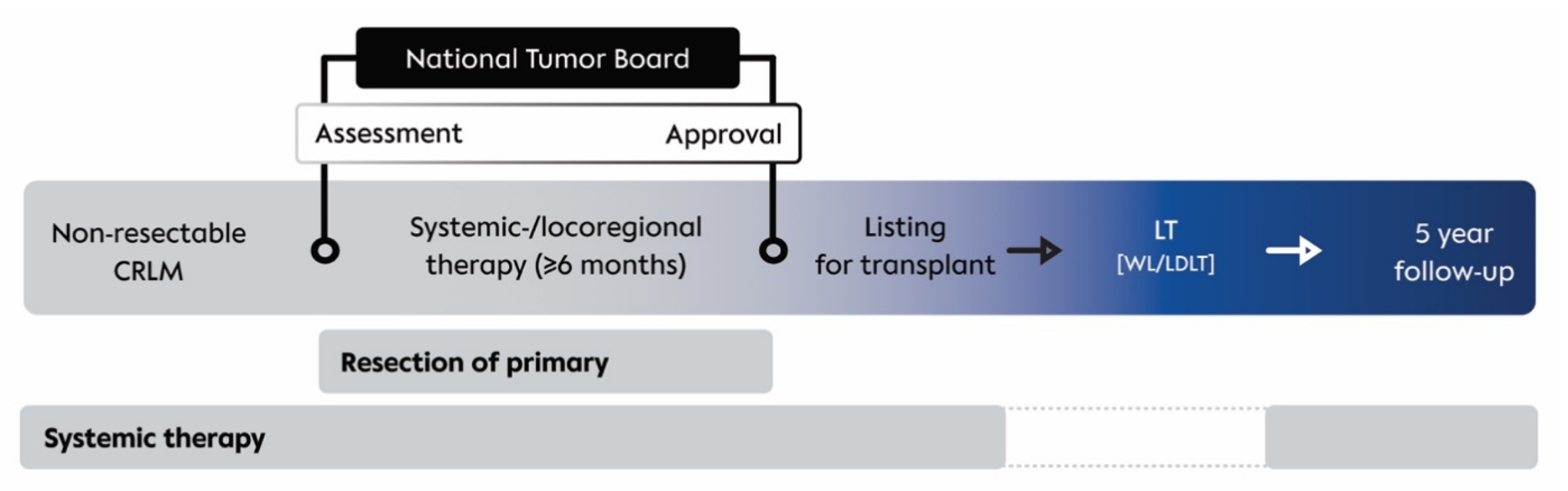
GTO-001 is a prospective, non-randomized interventional trial planned at up to 19 centers in Germany. Eligible patients are aged 18 to 65 years, have had their primary tumor removed, show no disease outside the liver, and have liver metastases that have remained stable for at least six months under chemotherapy. Every case is reviewed centrally by the “National Tumor Board for Transplant Oncology”, established specifically for the trial, in which experienced surgeons, radiologists and oncologists meet by videoconference. The board approves listing only if resection or ablation has been ruled out and all study criteria are met.
The protocol builds on the TransMet trial, the Toronto protocol and the consensus guidelines of the International Hepato-Pancreato-Biliary Association; in addition, the metabolic tumor volume measured by PET imaging serves as a selection criterion. Grafts come either from deceased donors allocated via Eurotransplant or from living donors. Immediately before transplantation, surgical exploration rules out tumor spread beyond the liver.
Endpoints and outlook
The primary endpoint is 5-year survival after liver transplantation: the trial aims to show that more than half of the transplanted patients are alive after five years. Because only a small proportion of patients meet all criteria up to transplantation, around 260 patients will be assessed in order to reach 26 transplantations. Secondary endpoints include overall and recurrence-free survival, graft survival and postoperative complications; exploratory analyses address risk scores and circulating tumor DNA.
If successful, the trial could provide the evidence base for including liver transplantation for unresectable colorectal liver metastases in the German guidelines for organ transplantation. Given the shortage of donor organs, it is essential that grafts are used where long-term benefit can be expected. At the same time, risks remain – including tumor recurrence under immunosuppression.
Prof. Raschzok is the overall study lead, and PD Dr. med. Simon Moosburner, MHBA and Fellow of the BIH Charité Clinician Scientist Programm, serves as Coordinating Investigator. The trial is overseen by an international Data Safety Monitoring Board (Dr. Elena Elez, Barcelona; Prof. Chiara Cremolini, Pisa; Prof. Pål-Dag Line, Oslo; Dr. Gonzalo Sapisochin, Toronto), an Advisory Board led by Prof. René Adam (Paris), and a Steering Committee comprising Prof. Igor M. Sauer, Prof. Johann Pratschke and Prof. Dominik P. Modest (Charité). The patient organization Lebertransplantierte Deutschland e. V. contributed to the study design; the trial is independent of industry. The ethics application is in preparation, and the trial is scheduled to start in April 2027.